
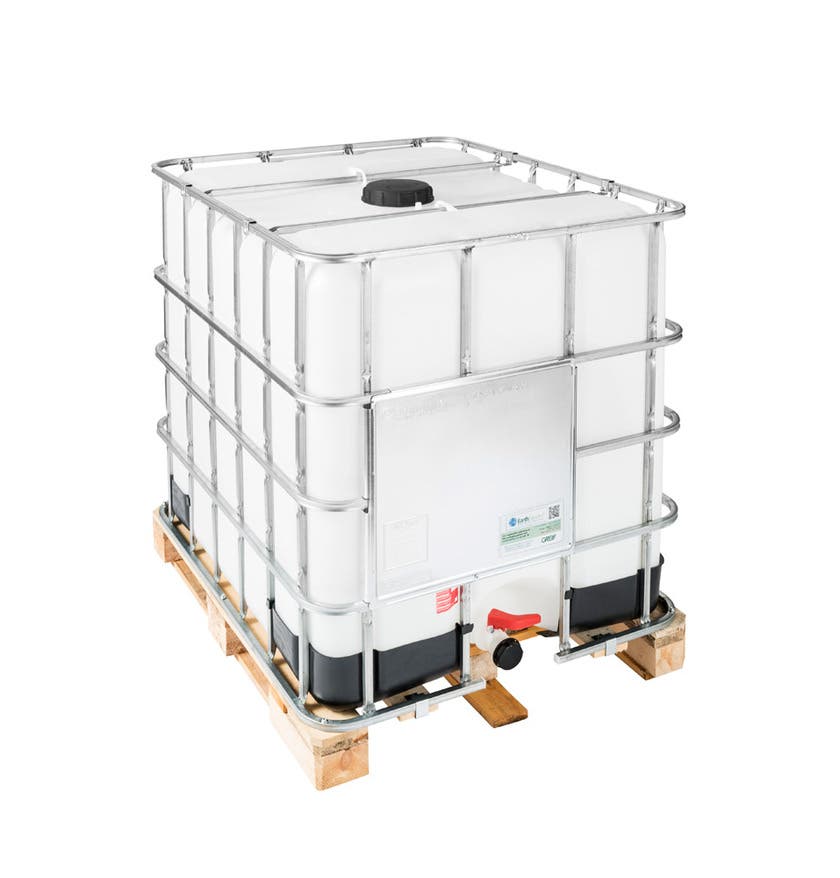
Urea 40% 1000l IBC
Art.No. 111000
- Marine urea solution used for vessels with heavy-duty diesel engines
- Reduces the level of nitrogen oxide emissions
Arom-dekor Kemi supplies Urea / AUS 40% in accordance with the strict specifications established by manufacturers of marine SCR systems. Urea solution is a colourless liquid with a faint characteristic odour that is harmless to both humans and animals. It is not toxic, does not burn and is non-explosive.
We also deliver UREA/AUS40 by tanker; contact us for more information or a quotation
What is Urea 40 % / AUS 40?
Urea 40 % (also known as AUS 40 = Aqueous Urea Solution 40 %) is an aqueous solution containing approximately 40 % urea and 60 % deionised water.
This solution is used in SCR systems (selective catalytic reduction) to reduce nitrogen oxide emissions (NOₓ) from diesel engines, particularly in shipping and larger industrial applications.
The term “AUS 40” is used primarily in maritime applications, while “Urea 40 %” can be used more generally.
How the product works
To meet the emission standards that have gradually begun to apply to vessels with heavy-duty diesel engines, vessels are now built with or retrofitted with marine SCR systems (selective exhaust treatment) to reduce the level of nitrogen oxide (NOx) emissions. This system requires a reducing agent to reduce the NOx gases, in the form of a marine urea solution (40% urea concentration in deionised water).
When the urea solution is injected into the exhaust system, heat converts the urea into ammonia (NH₃). This ammonia reacts with nitrogen oxides (NOₓ) inside the SCR system and converts them into harmless nitrogen (N₂) and water (H₂O).
Through this process, Urea 40 % / AUS 40 helps vehicles and machinery with diesel engines meet stringent emission requirements and reduce their environmental impact.
Why choose Urea 40 % from us?
-
High quality and purity: The product is manufactured to meet high standards, which is essential for SCR systems to function correctly and avoid damage.
-
Adapted for larger diesel engines / marine use: The 40 % concentration provides a greater effect when used with large engines and under demanding operating conditions.
-
Logistics and packaging for industrial use: Bulk deliveries, IBCs, tanker distribution, etc – ideal for companies handling larger volumes.
Use and storage – important tips
-
Store the solution in suitable tanks with controlled material and temperature handling. For example, AUS 40 requires tanks and systems to comply with the standard ISO 18611 for marine use.
-
The recommended storage temperature is often between +5 °C and +25 °C to avoid freezing and crystal formation.
-
Use a dedicated pump and hose for the product, and avoid contamination (oil, particulate matter, water) – this affects the function and service life of the SCR system.
-
Note that emission control and system requirements vary depending on the application – especially if the product is used in vessels covered by MARPOL or similar regulations.
Specifications at a glance
-
Urea solution approximately 40 % by mass (% m/m)
-
Density at 20 °C: approx. 1105-1177 kg/m³
-
Concentration and purity are critical to meeting emission and warranty requirements. Using a product with the wrong concentration or impurities can lead to damage to the SCR system and non-compliance.
Frequently asked questions (FAQ)
What distinguishes Urea 40 % / AUS 40 from, for example, AdBlue® or AUS 32?
AdBlue® (and AUS 32 in general) is a solution containing ~ 32,5 % urea and is used in road transport (trucks, buses) for SCR systems whose engines are adapted for this.
AUS 40 has a higher concentration and is designed for larger engines or marine use – and is not interchangeable with solutions for road vehicles. Using the wrong product can cause operational disruptions, termination of warranties or violations of emission regulations.
What is the shelf life of the product?
Shelf life varies depending on storage temperature, but for marine urea solution (~ 40 %), for example, up to 12-18 months is often stated when stored between 0-25 °C.
What protection is required in the event of a spill or contact?
Although the product is not highly hazardous, contact with skin/eyes may require rinsing with water. Always read the current safety data sheet (SDS).