

EFFINOX®: protect the SCR system before crystallization causes downtime
Crystallization in the SCR system can start as a small deposit around an injector and end with fault codes, workshop visits, component replacements and a vehicle that is out of service. EFFINOX® is a premium solution based on AdBlue®, developed both to prevent the buildup of urea deposits and to reduce deposits that have already formed.

From small crystals to a major problem
A small white deposit around an injector does not necessarily mean an immediate breakdown.
The problem is what can happen if the deposits continue to build up.
Over time, crystallization can affect AdBlue® dosing, restrict flow, block the injector or create deposits further into the exhaust aftertreatment system.
The result can be fault codes from the SCR system, impaired operation and a need for troubleshooting or cleaning. In more serious cases, the vehicle's performance may be limited or the vehicle may need to be taken out of service.
This is why crystallization should be seen as an operating-cost problem, not just a chemical problem.
The cost goes beyond the replacement part
When an SCR-related fault occurs, the cost rarely consists only of the component that needs to be repaired.
In addition to the direct workshop cost, there may also be diagnostics, cleaning, spare parts, labor, towing, replacement vehicles and lost production.
For a transport company, a stationary vehicle can also mean delayed deliveries and rescheduling both drivers and other vehicles.
For a contractor, a similar fault can mean that a machine cannot be used when it is needed most.
For a farm, unplanned downtime during a time-critical period can have much greater consequences than the repair cost itself.
...and some SCR components are expensive.
The real question is therefore not:
"What does EFFINOX® cost compared with regular AdBlue®?"
The more relevant question is:
"What does it cost us if a vehicle is out of service because of problems that could have been prevented?"
Preventive maintenance in liquid form
EFFINOX® can be seen as a way of shifting the focus from reactive to preventive maintenance.
Traditionally, the cost arises only once the problem has become serious enough. A warning light comes on, a fault code is recorded or the vehicle's SCR system starts to malfunction. Troubleshooting then begins.
With EFFINOX®, the idea is to address one of the causes earlier.
The product is developed for continuous use and to counter the gradual buildup of deposits that can otherwise develop over time.
This makes EFFINOX® particularly relevant for businesses where the same operating patterns recur day after day.
A delivery vehicle making hundreds of stops every week.
A bus that is constantly accelerating and stopping.
A garbage truck working slowly through residential areas.
A wheel loader operating under varying loads.
A tractor working under conditions where the engine is not always optimally loaded.
Not every individual journey necessarily creates a problem. It is the repeated exposure over time that makes preventive action relevant.
EFFINOX® works both preventively and correctively
This is one of the most important properties of EFFINOX®.
There are several solutions on the market developed to reduce the risk of crystallization. When comparing different products, it is therefore relevant not only to ask whether the product can prevent deposits.
Also ask:
What happens to the deposits already in the system?
EFFINOX® is developed for both preventive and corrective action. GreenChem states that the formulation not only counteracts new crystal formation but also reduces existing urea deposits in components including dosing lines and injectors.
This is an important difference for a vehicle that has already started showing signs of crystallization.
However, EFFINOX® should not be regarded as a mechanical repair. A broken sensor, damaged injector or defective catalytic converter is not repaired by changing the fluid. The product is developed to reduce a specific problem: the buildup of urea deposits and crystallization in the SCR system.
Tested in real urban traffic
EFFINOX® has also been tested under conditions where the risk of crystallization is particularly relevant.
Even before the test, the vehicle had clear urea deposits in its SCR system, particularly around the injector.
The bus covered approximately 13,000 kilometers using EFFINOX®.
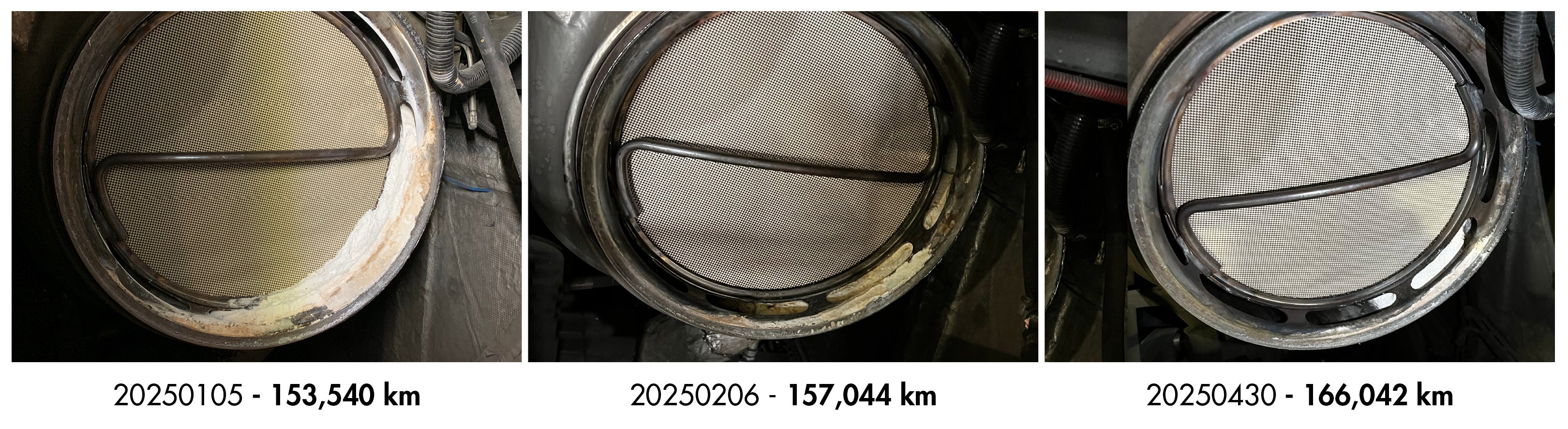
When the system was examined after the test period, a visible reduction in crystallization and existing deposits was reported. The injector was not blocked and no AdBlue®-related fault codes were recorded during the test period.
The frequency of SCR-related maintenance also decreased during the trial.
What makes the test interesting is not only that new crystallization could be counteracted.
The system already had deposits when the test began.
This makes the trial particularly relevant for businesses that have already identified recurring problems in their vehicle fleets.
From recurring injector problems to more reliable operation
Another example comes from the Dutch transport company Van Leeuwen Container Service.
The company operates around 60 trucks and had recurring problems with crystallization around the SCR injectors. According to the company, the problems involved costly repairs, towing and unplanned downtime.
EFFINOX® then began to be used as the main SCR fluid.
During the first six months, the business used approximately 45,000 liters of EFFINOX®, while around 5,000 liters of regular AdBlue® were filled up when the vehicles were out on the road.
For Van Leeuwen, the value was therefore not primarily in the fluid itself. The savings came from reduced downtime, fewer emergency repairs and more predictable vehicle operation.
Prevent the problem before the warning light comes on
An SCR system that has already caused downtime is expensive.
An SCR problem that never needs to arise is considerably less expensive.
EFFINOX®: Premium AdBlue® developed to prevent crystallization, reduce existing deposits and contribute to a more reliable vehicle fleet.